
Ultrafast Laser Annealing of HZO Thin Films
Ultrafast thermal processing to unlock ferroelectric phases in next‑generation memory materials
Project Overview
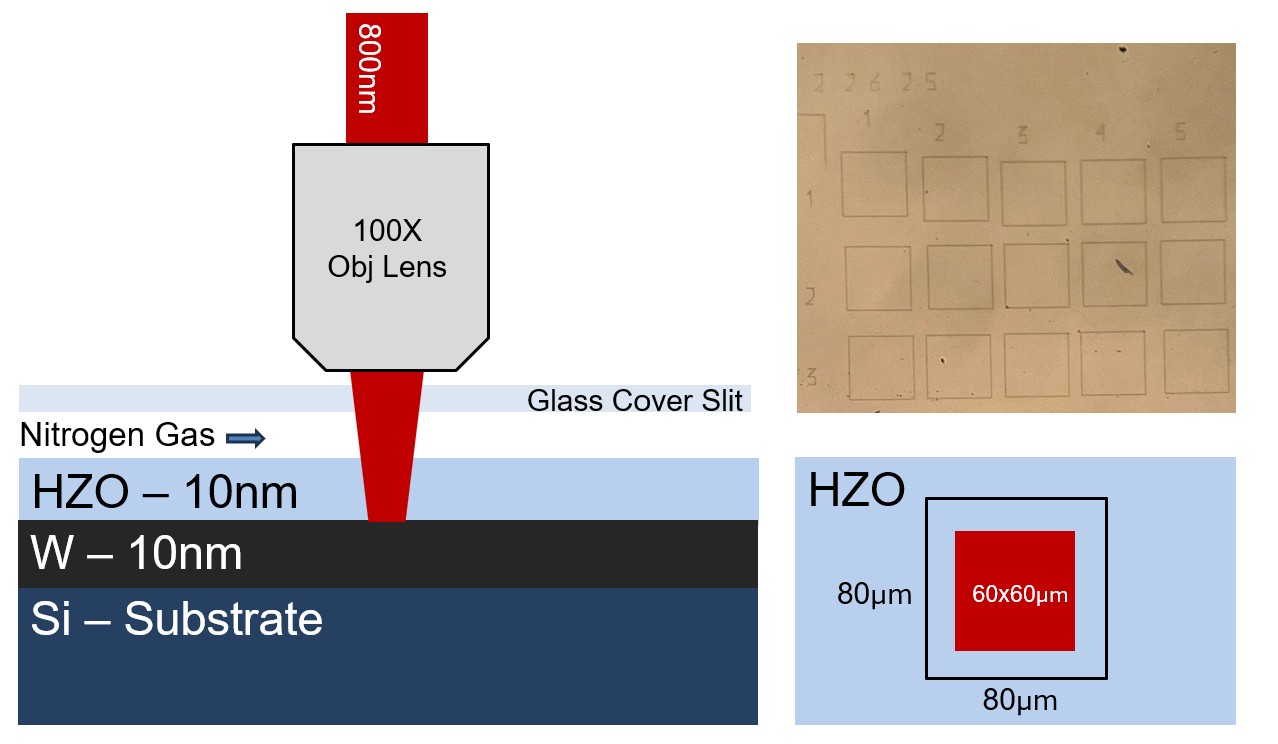
This work explores femtosecond‑pulse laser annealing as a low‑thermal‑budget route to crystallize 10 nm HZO layers deposited on a 10 nm bottom electrode (tungsten or titanium nitride). We couple 1‑D Heat Transfer Simulation in MATLAB with ex‑situ spectroscopy to study changes in crystal integrity and vacancies, along with GIXRD, nano-FTIR, and PE-analysis, aiming to stabilize the polar orthorhombic phase required for non‑volatile ferroelectric memories. The goal is to eliminate the need for a top electrode during annealing, reducing total fabrication time and cost versus rapid‑thermal annealing (RTA).
Key Contents
- TMM Optical Model
- 1-D Heat Transfer Model
- Femtosecond Laser Annealing
- Crystal Phase detection
TMM Optical Model - Matlab
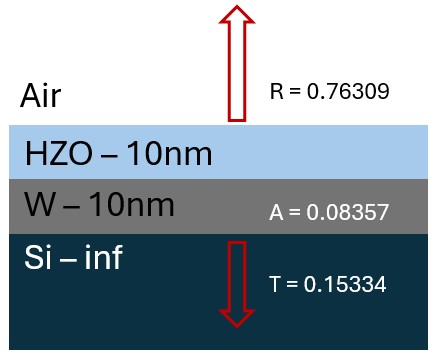
This section provides a minimal, normal-incidence Transfer-Matrix Method (TMM) implementation to evaluate the optical response of the Air | HZO | W | Si(∞) stack at 800 nm. The script interpolates complex refractive indices (n, k) for HZO, W, and Si from your datasets, accepts layer thicknesses (default 10 nm each for HZO and W), builds the characteristic matrix, and computes reflectance (R), transmittance (T, with the correct admittance ratio into absorbing Si), and absorptance A=1−R−T. For our nominal stack and optical constants, the single-wavelength result gives absorptance ~8.3% at 800 nm, which you can tune by adjusting thicknesses or materials; the same code can be extended to sweep wavelength for full R/T/A spectra and to feed dose-relevant A into your 1-D thermal model.
1D Heat Transfer Model - Matlab
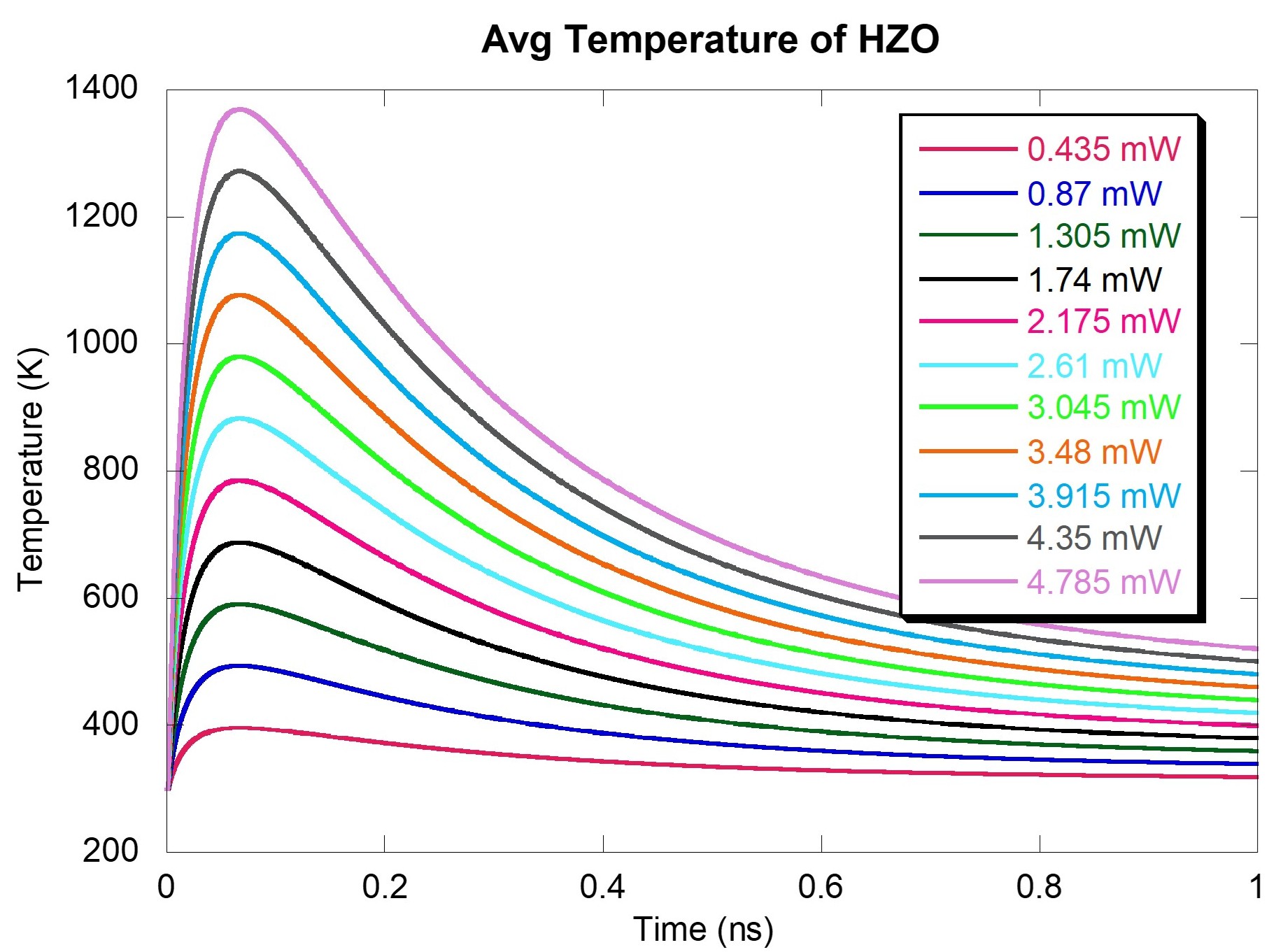
This MATLAB script models ultrafast laser heating in a multilayer thin-film stack (HZO/W/Si) and visualizes how temperature evolves in space and time. It first interpolates the optical constants at 800 nm to compute reflectivity and the absorption depth, then converts the average femtosecond-laser power (single-pulse, 120 fs at 5 kHz, square ~60 µm spot) into a depth-dependent volumetric heat source applied to a selectable absorbing layer (here, W). The stack is discretized at nanometer resolution with material properties (k, cp, ρ) and interfacial thermal resistances (including air–film boundaries), and a finite-volume transient solver advances the 1D heat equation over ~5 ns with 10⁻¹⁴ s steps. The code outputs surface and internal temperatures vs. time, peak-temperature profiles across depth, a 2D space–time heatmap, and the layer-averaged HZO temperature; it also reports estimated memory usage and can export CSV files for post-processing and figure generation.
Selected Results
Null placeholder — results discussion coming soon.